Thursday, December 20, 2012

TC: That time of year


.


Boy beside store window display of Christmas ornaments: photographer unknown [Jack Delano?], December 1941 (Farm Security Administration/Office of War Information Collection, Library of Congress)


Delmore Schwartz: The Winter Twilight, Glowing Black and Gold


That time of year you may in me behold
When Christmas trees are blazing on the walk,
Raging amid stale snow against the cold
And low sky's bundled wash, senseless as chalk.
Hissing and ravenous the brilliant plant,
Rising like eagerness, a rushing pyre
(As when the tutti bursts forth, and the chant
Soars up -- hurrahing! -- from the Easter choir).

But this is only true at four o'clock,
At noon the fifth year is once more abused,
I bring a distant girl apples and cake,
Pictures, secrets, lastly my swollen heart,
Now boxed and tied by what I know of art
-- But as before accepted and refused.


Delmore Schwartz: The Winter Twilight, Glowing Black and Gold, from Vaudeville for a Princess and Other Poems, 1950


http://memory.loc.gov/service/pnp/fsac/1a34000/1a34400/1a34414v.jpg

Boys looking at store window display of toys: photographer unknown [Jack Delano?], December 1941 (Farm Security Administration/Office of War Information Collection, Library of Congress)


William Shakespeare: Sonnet 73: That time of yeeare thou maiſt in me behold


http://extra.shu.ac.uk/emls/Sonnets/e4r.jpg

William Shakespeare: Sonnet 73 (1609 quarto)


That time of yeeare thou maiſt in me behold,  
When yellow leaues, or none, or fewe doe hange  
Vpon thoſe boughes which ſhake againſt the could,  
Bare rn'wd quiers, where late the ſweet birds ſang.
In me thou ſeeſt the twi-light of ſuch day,  
As after Sun-ſet fadeth in the Weſt,  
Which by and by blacke night doth take away,  
Deaths ſecond ſelfe that ſeals vp all in reſt.
In me thou ſeeſt the glowing of ſuch fire,  
That on the aſhes of his youth doth lye,  
As the death bed, whereon it muſt expire,  
Conſum'd with that which it was nurriſht by.
   This thou perceu'ſt, which makes thy loue more ſtrong,
   To loue that well, which thou muſt leaue ere long.


 William Shakespeare: Sonnet 73: That time of yeeare thou maiſt in me behold, from 1609 Quarto


http://memory.loc.gov/service/pnp/fsac/1a34000/1a34400/1a34409v.jpg

Christmas trees and wreaths in store window display, photographer unknown [Jack Delano?], December 1941 (Farm Security Administration/Office of War Information Collection, Library of Congress)


Shoppers walk through fake snow on Oxford Street during a traffic-free Christmas shopping day in central London: photo by Olivia Harris/Reuters, 24 November 2012

Sunday, December 9, 2012

TC: Waning Crescent Moon


.


http://lcweb2.loc.gov/service/pnp/jpd/02000/02021v.jpg

Yumiharizuki (Bow-shaped moon), from Tsuki nijūhakkei no uchi: 28 views of the moon
: Hiroshige Ando (1797-1858), [185-, printed later] (H. Irving Olds Collection/Japanese Prints and Drawings, Library of Congress)


Later the light
spike heel hoof
click
of the California mule

Deer
cantering
up the middle
of Colusa

In deep night
under a waning

crescent
moon


http://lcweb2.loc.gov/service/pnp/jpd/01400/01471v.jpg

Bird flying with faint crescent moon in background: artist unknown, between 1870 and 1920, from series of illustrated sheets (Japanese Fine Prints, Library of Congress)


http://lcweb2.loc.gov/service/pnp/jpd/01400/01472v.jpg

Red sun surrounded by feathers above the ocean: artist unknown, between 1870 and 1920, from series of illustrated sheets (Japanese Fine Prints, Library of Congress)


The thin gold shaving of the moon floating slowly downwards had lost itself on the darkened surface of the waters, and the eternity beyond the sky seemed to come down nearer to the earth, with the augmented glitter of the stars, with the more profound sombreness in the lustre of the half-transparent dome covering the flat disc of an opaque sea.  The ship moved so smoothly that her onward motion was imperceptible to the senses of men, as though she had been a crowded planet speeding through dark spaces of ether behind the swarm of suns, in the appalling and calm solitudes awaiting the breath of future creations.
Joseph Conrad: Lord Jim, 1900

Wednesday, November 28, 2012

TC: Now She Dwells Here


.


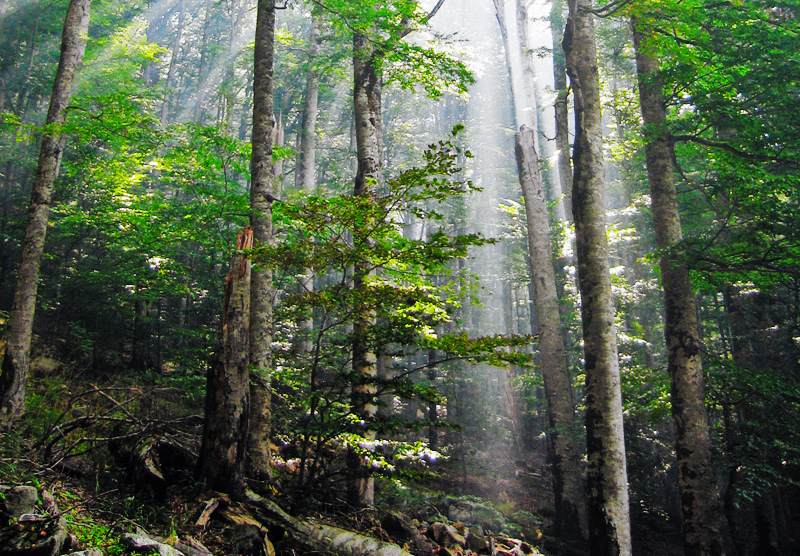
File:Biogradska suma.jpg

Old growth European Beech forest, Biogradska National Park, Montenegro: photo by Snezana Trifunovic, 2007


It was the work of fortune
which brings joy and not pain only.
But can a winged thing become less?

She lived on E. 75th Street
to speak plainly.

I mean: in the divisiveness of love
two people pass through
the same instant separately

for all their awareness sighs
for life and not for each other
but in doing that it does.


(1968)

Monday, November 12, 2012

TC: (Re)Possession


.


Rainy Night: Charles Burchfield, 1918 (The Phillips Collection, Washington, D.C.)


He creeps round the eerie empty houses at night
the cry of a lost soul illuminating a late window
on foreclosure and dispossession

The night stalker
alone, driving for hours through abandoned
neighborhoods, senses a curious

elation -- calmed for once, for once feeling almost
at home -- as though the light left on in 
the vacant house had been lit

there for a ghost -- for him, alone -- 


2152

Untitled 2152, 1998: photo by Todd Hido (Kaune, Sudendorf Gallery for Contemporary Photography, Cologne)

2524_1999

Untitled 2524, 1999: photo by Todd Hido (Kaune, Sudendorf Gallery for Contemporary Photography, Cologne)
1968

Untitled 1968, 1997: photo by Todd Hido (Kaune, Sudendorf Gallery for Contemporary Photography, Cologne)

1922-c

Untitled 1922-c, 1997: photo by Todd Hido (Kaune, Sudendorf Gallery for Contemporary Photography, Cologne)

2312-a

Untitled 2312-a: photo by Todd Hido, 1999 (Kaune, Sudendorf Gallery for Contemporary Photography, Cologne)
photo

Untitled 1738: photo by Todd Hido, 2003
 (Bruce Silverstein Gallery, New York)

photo


Untitled 1726: photo by Todd Hido, 1996 (Bruce Silverstein Gallery, New York)
1975-a_1996

Untitled 1975-1-a: photo by Todd Hido, 1996 (Kaune, Sudendorf Gallery for Contemporary Photography, Cologne)

2736_2000

Untitled 2376: photo by Todd Hido, 2000 (Kaune, Sudendorf Gallery for Contemporary Photography, Cologne)
3510

Untitled 3510: photo by Todd Hido, 2008 (Kaune, Sudendorf Gallery for Contemporary Photography, Cologne)
2077_1998

Untitled 2077: photo by Todd Hido, 1998 (Kaune, Sudendorf Gallery for Contemporary Photography, Cologne)
photo

Untitled 1154-a: photo by Todd Hido, 1998
(Bruce Silverstein Gallery, New York)

photo

Untitled 8350: photo by Todd Hido, 2009
(Bruce Silverstein Gallery, New York)


File:Curtain light.JPG

White curtain in warm light: photo by Christoph Michels, 2006

File:Foreclosedhome.JPG

Half million dollar house under foreclosure, Salinas, California
: photo by Brendel, 13 February 2008

Monday, October 8, 2012

TC: 1968


.


File:Schiefeebene.jpg

Die Schiefe Ebene der Szalajkabahn in Ungarn
: photo by E. Scherer, 2007


All the while I was
being numbered and

stored by history
as an example
of something
as flat and thin
as a picture
in a textbook
or an image
on film
I remained under
the illusion I was
merely living


File:Chardo.jpg

Goldfinches: photo by Monster 2000, 2008

Thursday, September 13, 2012

TC: On the Beach


.


File:Brighton Beach, Melbourne 2003 (91593941).jpg


The storm has ended and death steps back
Into the waters once more.  All our troubles
Are behind us once and for all.
The moon looks down in single glory.
The apocalyptic view of the world
Supposes things do not repeat themselves.
But they do.  And they do.  And they do.
The sky clouds up.  A new storm comes on.
Apocalyptic thinking presumes
All this has never happened before
And will never happen again. I know,
As the moon beams down on the photo-plankton,
All this will never happen again, too.
Wisdom is cold and to that extent stupid.


Brighton Beach, Melbourne, after the storm: photo by Beau Wade, 2003


Tuesday, July 3, 2012

TC: Marcel Proust: Night Train


.

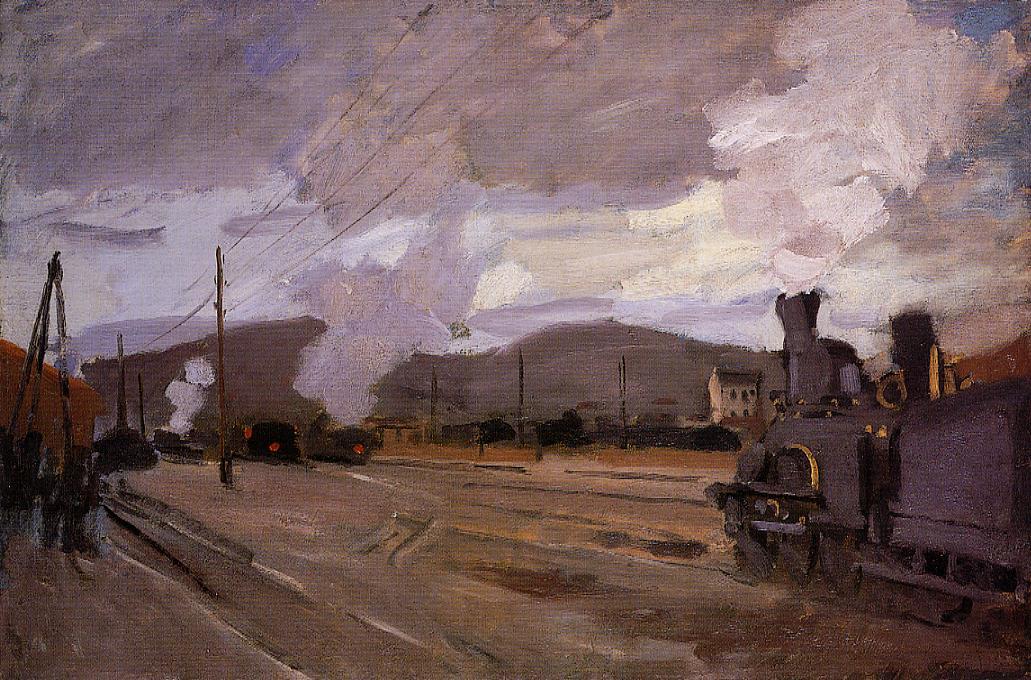
File:Claude Monet - The Gare 
d'Argenteuil.jpg

The Gare d'Argenteuil: Claude Monet, 1872 (Musée Tavet-Delacour / Musée de Luzarches, Conseil général de Val d'Oise)


For a long time I used to go to bed early. Sometimes, when I had put out my candle, my eyes would close so quickly that I had not even time to say "I'm going to sleep." And half an hour later the thought that it was time to go to sleep would awaken me; I would try to put away the book which, I imagined, was still in my hands, and to blow out the light; I had been thinking all the time, while I was asleep, of what I had just been reading, but my thoughts had run into a channel of their own, until I myself seemed actually to have become the subject of my book: a church, a quartet, the rivalry between François I and Charles V. This impression would persist for some moments after I was awake; it did not disturb my mind, but it lay like scales upon my eyes and prevented them from registering the fact that the candle was no longer burning. Then it would begin to seem unintelligible, as the thoughts of a former existence must be to a reincarnate spirit; the subject of my book would separate itself from me, leaving me free to choose whether I would form part of it or no; and at the same time my sight would return and I would be astonished to find myself in a state of darkness, pleasant and restful enough for the eyes, and even more, perhaps, for my mind, to which it appeared incomprehensible, without a cause, a matter dark indeed. 

I would ask myself what o'clock it could be; I could hear the whistling of trains, which, now nearer and now farther off, punctuating the distance like the note of a bird in a forest, shewed me in perspective the deserted countryside through which a traveller would be hurrying towards the nearest station: the path that he followed being fixed for ever in his memory by the general excitement due to being in a strange place, to doing unusual things, to the last words of conversation, to farewells exchanged beneath an unfamiliar lamp which echoed still in his ears amid the silence of the night; and to the delightful prospect of being once again at home. 

I would lay my cheeks gently against the comfortable cheeks of my pillow, as plump and blooming as the cheeks of babyhood. Or I would strike a match to look at my watch. Nearly midnight. The hour when an invalid, who has been obliged to start on a journey and to sleep in a strange hotel, awakens in a moment of illness and sees with glad relief a streak of daylight showing under his bedroom door. Oh, joy of joys! it is morning. The servants will be about in a minute: he can ring, and some one will come to look after him. The thought of being made comfortable gives him strength to endure his pain. He is certain he heard footsteps: they come nearer, and then die away. The ray of light beneath his door is extinguished. It is midnight; some one has turned out the gas; the last servant has gone to bed, and he must lie all night in agony with no one to bring him any help.


File:MS A la recherche du temps perdu.jpg

A la recherche du temps perdu: Du coté de chez Swann, first galley proof, handwritten revisions by Marcel Proust


Marcel Proust, from Du coté de chez Swann (Swann's Way), 1913: Volume One of A la recherche du temps perdu (Remembrance of Things Past), translated by  C. K. Scott Moncrieff, 1922