.
Saturday, December 21, 2013
TC: Solstice ("Cold floating days...")
.
House sparrow (Passer domesticus) with winter plumage: photo by 3268zauber, 3 January 2009
Cold floating
days, difficult to keep body
Temp. up as planet
cools off mysteriously
This P.M. two
small grey birds bump
Around in the rose
bush for a while
A capella (no rush
hour for once)
In last rays of
tinny Christmas sun
While voluntary trumpets
are quietly
Emitted by radio
into Jerusalem foiled sky
Far off and to our
great astonishment
O blue earth
sounds your golden flower
From the bell of
its silver horn
I didn’t think it
would ever come back on
House sparrow (Passer domesticus) in non-breeding plumage: photo by 3268zauber, 3 January 2009
Wednesday, November 13, 2013
TC: Last Bus
.
Golden Gate: Gerhard Richter, 1989, oil on photograph, 10 x 15 cm (Gerhard Richter Art)
The last bus one hour and twelve minutes late
at the bleak nearly deserted downtown stop
and when I enquire of the only person waiting
at the kiosk
whether the bus may have already gone past
He says Fuck off don't you try to talk to me
and turns his back
and high above him atop the new tower block
the giant neon lights advertising
the hotel that wasn't there the last time I looked
flash on and off
advertising the five luxury dining rooms.
Tom Clark: Last Bus, from Truth Game (BlazeVOX, 2013)
Untitled (1.5.89): Gerhard Richter, 1989, oil on colour photograph, 15 x 10 cm (Gerhard Richter Art)
Beach at Land's End: photo by DaNASCAT, 4 July 2010
Golden Gate Bridge: cracks and spalling to the paintwork due to relative movements of the steel cable: Golden Gate Bridge architecture: photo by Tewy, 19 July 2006
Suicide prevention message, Golden Gate Bridge: photo by David Corby, 19 February 2006
Friday, October 18, 2013
TC: Robert Creeley: Generous Life
.
Ella: Gerhard Richter, 2007 (private collection)
Do you remember the way we used to sing
in church when we were young
and it was fun to bring your toys with you
and play with them while all the others sung?
My mind goes on its own particular way
and leaves my apparent body on its knees
to get up and walk as far as it can
if it still wants to and as it proves still able.
Sit down, says generous life, and stay awhile!
although it's irony that sets the table
and puts the meager food on broken dishes,
pours out the rancid wine, and walks away.
Betty: Gerhard Richter, 1991
(St. Louis Art Museum)
Robert Creeley: Generous Life from Yesterdays (2002)
Sunday, October 13, 2013
TC: Giuseppe Ungaretti: What would I want with images?
.
Waves on sandy beach, Cabo Polonio, Uruguay: photo by Johntex, 2006
..These wandering landscapes of the ocean's
Shifting surface, the incisive
Candour of daybreak on these
Or those leaves: these things no longer
Draw me; nor can my old eyes make
Out light from shade against the stones.
..Forgot, what would I want
With images?
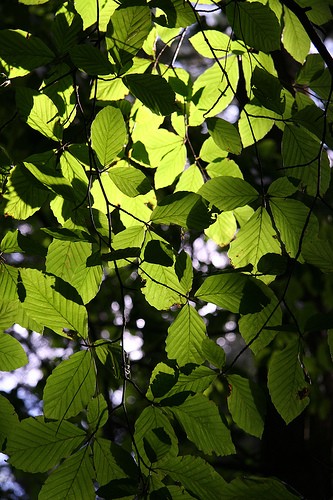
Leaves of European Birch (Fagus): photo by The cat, 2006
..Non più m'attragano i paesaggi erranti
Del mare, né dell'alba il lacerante
Pallore sopra queste o quelle foglie;
Nemmeno più contrasto col macigno,
Antica notte che sugli occhi porto.
..Le immagini a che prò
Per me dimenticata?
Per me dimenticata?
Foggy sunset with Brown Pelicans: photo by Mila Zinkova, 2009
Giuseppe Ungaretti: Poem IX (Non più m'attragano i paesaggi erranti) from Cori descrittivi di stati d'animo di Didone (Choruses Descriptive of the State of Mind of Dido), in La terra promessa (The Promised Land), 1950; English translation by TC
Sunday, September 1, 2013
TC: At Matanaka Farm
.
This granary, privy and schoolhouse at Matanaka [on the South Island] are New Zealand's oldest surviving farm buildings. The three largest buildings were prefabricated in Sydney, and the granary and stable still have their original "Patented Galvanised Tinned Iron" roofs. The stable has a harness room, stalls for the horses and a gig room. Fodder was stored in the loft and there was a dovecote in the loft at the north end. The storeroom was probably the place where bulk supplies were kept, since there are orders scribbled on the original interior lining. The granary stands, like the stable, on its original site. The privy, which was placed over a large pit, was once nearer the homestead. The school was originally a barn, here in the farmyard, but was shifted nearer to the house in the 19th century for use as a schoolroom. It was shifted back to the farmyard about the beginning of the 20th century. It is divided into a schoolroom and a room for the teacher: photo by Karora, 23 April 2008
This is not a memoir, so that
as we rolled over the small rise
and saw, set on
that bare hill, the plain
wooden farm buildings
painted a uniform
deep red, with faded
and lightly rusted corrugated
iron roofs, and tawny
grasses swaying all about
against the two
tone blue of sea and sky,
we knew
no one would remember
we had once
seen these things.
Matanaka farm building, Otago, New Zealand: photo by travelling light (Derek Smith and Maclean Barker), 30 August 2004
TC: At Matanaka Farm, from Truth Game
Wednesday, August 7, 2013
TC: Now (from Truth Game)
.
Untitled (window), Berkeley, c. 1957: photo by Dorothea Lange from Dorothea Lange Collection, Oakland Museum of California
The imaginal representation of the mind,
the only world left to you. Continuing on. That poor
second best for which one would give everything
simply to have something to go on. The twisted
oaks. The stone steps descending
through the grove to where the light of morning
no longer bathes the contorted upper limbs
alone, but pierces them, at intervals, in the interstices,
with slender shafts that penetrate
the lower limbs and chequered
patterns of light and shade there made, all the way
to the bottom of the steep path.
Untitled (oak tree), Berkeley, 5 December 1956: photo by Dorothea Lange from Dorothea Lange Collection, Oakland Museum of California
Untitled, Berkeley, c. 1957: photo by Dorothea Lange from Dorothea Lange Collection, Oakland Museum of California
Untitled (garden steps), Berkeley, c. 1957: photo by Dorothea Lange from Dorothea Lange Collection, Oakland Museum of California
Untitled (garden), Berkeley, c. 1957: photo by Dorothea Lange from Dorothea Lange Collection, Oakland Museum of California
Tom Clark: Now, from Truth Game, BlazeVOX 2013
Friday, June 7, 2013
TC: The Black Spot (Scott After the Pole)
.
Robert Falcon Scott (1868-1912), writing in his journal in the Cape Evans hut: photo by Herbert G. Ponting, 1911 (National Archives UK)
Had I but strength to stand, I'd walk out
Upon the ice and show you the strange sights
That glow within the black lights of the Pole.
Natural science cannot explain these lights.
Where nothing living breathes the personal
Must also hold its breath. The stirrings of the men
In restless sleep, their labored breathing.
I must write Wilson's mother a note, deceive
Her if I'm able as to the horror
Of his end. I'll tell her of his courage,
His selflessness, his loyalty to the men.
She'll have no need for the truth, no more
Than did we to be undeceived. Not till
Our bones are found will they find my letter.
"29th March. My dear Mrs. Wilson.
If this reaches you, Bill and I will have gone
Out together. We are very near it now
And I should like you to know how splendid
He was at the end. Everlastingly
Cheerful and ready to sacrifice
Himself for others, never a word of blame
To me for leading him into this mess.
He suffers only mild discomforts.
His eyes have a colorful blue look of hope
And his mind is peaceful with his faith.
My whole heart goes out to you in pity."
Can't see my marks yet still can grip this stub
And make it move across the page. Black spots
In the dark, marking what cannot be shown.
Black spots blur on white paper: what can
Be shown cannot be said. The hour grows late
For these meandering trains of thought
Represented by blurred spots on white paper.
Connect the dots and the limits of my world
Will grow apparent to you. Where in it am I?
This riddle does not exist as problem
In your life, where the light of the personal
Shines. The solution of the problem
Of life is the vanishing of the problem.
I am the microcosm, thought Scott
At the last, in the dark, as night closed in
Over permafrost. A black spot now his world
Growing to fill the whole vast snowbound landscape.
TC: The Black Spot (Scott After the Pole), from Feeling for the Ground, 2010
Upon the ice and show you the strange sights
That glow within the black lights of the Pole.
Natural science cannot explain these lights.
Where nothing living breathes the personal
Must also hold its breath. The stirrings of the men
In restless sleep, their labored breathing.
I must write Wilson's mother a note, deceive
Her if I'm able as to the horror
Of his end. I'll tell her of his courage,
His selflessness, his loyalty to the men.
She'll have no need for the truth, no more
Than did we to be undeceived. Not till
Our bones are found will they find my letter.
"29th March. My dear Mrs. Wilson.
If this reaches you, Bill and I will have gone
Out together. We are very near it now
And I should like you to know how splendid
He was at the end. Everlastingly
Cheerful and ready to sacrifice
Himself for others, never a word of blame
To me for leading him into this mess.
He suffers only mild discomforts.
His eyes have a colorful blue look of hope
And his mind is peaceful with his faith.
My whole heart goes out to you in pity."
Can't see my marks yet still can grip this stub
And make it move across the page. Black spots
In the dark, marking what cannot be shown.
Black spots blur on white paper: what can
Be shown cannot be said. The hour grows late
For these meandering trains of thought
Represented by blurred spots on white paper.
Connect the dots and the limits of my world
Will grow apparent to you. Where in it am I?
This riddle does not exist as problem
In your life, where the light of the personal
Shines. The solution of the problem
Of life is the vanishing of the problem.
I am the microcosm, thought Scott
At the last, in the dark, as night closed in
Over permafrost. A black spot now his world
Growing to fill the whole vast snowbound landscape.
TC: The Black Spot (Scott After the Pole), from Feeling for the Ground, 2010
Robert Falcon Scott's South Pole party on his ill-fated expedition, from left to right at the Pole: Lawrence Oates (standing), Henry Bowers (sitting), Scott (standing in front of Union Jack flag on pole), Edward Wilson (sitting), Edgar Evans (standing). Henry Bowers (1883-1912) took this photograph on the day of the party's arrival at the Pole, 17 January 1912, using a piece of string to operate the camera shutter: photo from Leonard Huxley (ed.), The Return from the Pole, in Scott's Last Expedition (volume 1), New York, 1913 (National Archives UK)
Icebergs in McMurdo Sound, as seen from McMurdo Station during Scott's last expedition: photo by Herbert Ponting, 1910; image by Wayne Ray, 31 March 2008 (private collection of Bruce Parker, London, Ontario)
"The
worst has happened... All the day dreams must go... Great God! This is
an awful place": Robert Falcon Scott, diary entry, 17 January 1912, upon
reaching the Pole, only to learn that Amundsen had preceded him by six
weeks.
Subscribe to:
Posts (Atom)