Wednesday, June 2, 2010

TC: Mnemonic


.

File:'Udaipur, 1916' woodblock print by  Charles Bartlett, 1917 .jpg


If on the moon palace stairs
A thin wash of water colour bleeding

Across the body chemistry frontier blurs,
As traffic slowly hones the blade of evening

And scatters its eyes across dusk's drift and growth,
That sharp outline we think of as reality,

It would perhaps be time to go to Plan B --
That is, to try to remember the colours of the morning.


File:'Taj Mahal, Sunset', woodblock by  Charles W. Bartlett, 1920.jpg


Udaipur: Charles W. Bartlett, 1916 (Honolulu Academy of Fine Arts)
Taj Mahal, Sunset: Charles W. Bartlett, 1920 (Honolulu Academy of Fine Arts)

Friday, May 14, 2010

TC: Pink Trees


.


Selden Connor Gile, Pink Trees


The message erupts each springtime
What we do know we don't know till we know it
Has slipped away through the airy spring branches
To drift up in thin grains through the gray-white sky
And here on the blue clay earth below it
Down a yellow Spanish East Bay hillside flow
The pink trees


Pink Trees: Selden Connor Gile, 1919

Wednesday, May 12, 2010

TC: Curve


.

File:Máscara de Xiuhtecuhtli Cultura  Azteza-Mixteca Ars Summum.JPG


The money

value

of

art

will keep

rising


because the

value

of

money

will keep

falling


File:Hirst-Love-Of-God.jpg


Máscara de Xiuhtecuhtli: representation of Xiuhtecuhtli (Lord Turquoise), Central Mexican god of fire. Mosaic of turquoise inlay and other materials. Mixtec-Aztec, c. 1400-1521: photo by Manuel Parada López de Corselas, 2007 (British Museum, London)

For the Love of God
: sculpture by Damien Hirst, 2007. Platinum cast of a human skull covered with 8,601 diamonds. Displayed at White Cube Gallery, London, asking price 50 million pounds. Copyright Damien Hirst, 2007 (photo via Daily Telegraph)


"... the desire incarnate in money offered a reward to the imagination, as between two lovers; and that reward seemed at first to be guaranteed by rare and beautiful metals, of whose inner nature and capacity men could only dream. In time, that guarantee was unveiled as only the projected authority of a community... It was the community that authorised the wishes expressed in money or frustrated them. To use money was to submit to the state, and when states disintegrated their moneys vanished as completely as their laws..." James Buchan, Frozen Desire: Macmillan, London, 1997

Wednesday, April 28, 2010

TC: Paradiso Terrestre


We have always been here

It was always ours


words not as signs but as powers

of suggestion


this is paradise

in the present tense


no seconds no

minutes no hours


no distance between

object and expression


what is seen or heard

felt in the same moment


by the one who sees and the one

who is seen


the one who speaks

and the hearer of the word


all creatures bound

by a kinship persisting


until appeared

the middle managers


and thus began

history


the vision thickened

the speech grew slurred


and awkward

and everything stopped


promise by maxivida.


Playa paraiso: photo by Michela Chemello, 2009

Promise: photo by Maxivida, 2006

Friday, April 23, 2010

TC: The New World and Trans/Versions: Two Views


.


Tom Clark: The New World and Trans/Versions: Libellum, 2009


I...Michael Lally


Poet and translator Vincent Katz's Libellum press is proof that fine book making is not only not dead but alive and dancing.

The two latest publications from Libellum solidify the burgeoning reputation of the press as not only successful at creating fine books but at making available fine poetry.

Poet Tom Clark has been the main contributor to the Vanitas blog and is the sole contributor to his own poetry blog—TOM CLARK/BEYOND THE PALE—which to my mind is the best strictly poetry blog (where you go to read poetry, not opinions about it) on the web.

Now they've come together in the form of two books—THE NEW WORLD and TRANS/VERSIONS.


The latter is what some folks call a "chapbook"—meaning it's a very slim volume with a "saddle stitched" binding (meaning the pages are held together by two staples in the center of the middle two-page spread over which the pages are folded) and contains seven poems based on or translated from poems from other languages, including from the French (Baudelaire, Rimbaud, Mallarme and Reverdy), Spanish (two poems by Vallejo) and German (Brecht).

They are delightfully insightful into the original intent, I believe, of the poets and of Clark's capacity for a kind of wisdom that few poets ever attain but most seem to always be writing as if they have. But Clark rarely if ever comes across as the sage, more like the older version of the guy who first made his mark as a humorous but brash young poet of the late 1960s and early '70s whose work fairly jumped off the page with the vitality of those times.

(Here's the last three lines from "Vallejo: The Vedic Fiber"—"What hasn't yet come along won't, but/what's already come and gone,/but what's already come and gone.")


I first learned of Clark as the poetry editor of The Paris Review who replaced the outdated stolid seriousness of poems based on what seemed by then ancient rhythms and/or self-serious ponderance with lighthearted, witty, and often close to incomprehensible experiments with language and subject matter that matched the musical soundtrack of those years.

He introduced us all to poets and styles that were what a lot of us had been trying to do ourselves or had at least been looking for and hoping others would discover and share, and there they all were, or a lot of them, in the poetry published in The Paris Review in those years.

Now, through his poetry blog BEYOND THE PALE he has become the sage our age needs (I mean "our age" as both these times and his and my actual years alive) and these two books demonstrate that for me. They still have a kind of ease with language that makes a lot of his lines seem conversational and simple, sometimes to the point of seeming obviousness, but then, there'll be that little or not so little turning on-a-dime that transforms what seemed simple and perhaps a given into something so much more subtle and graceful in ways only poetry seems capable of.

The poems in THE NEW WORLD capture that well, especially the ones that are more narrative, little stories about the people he encounters on his rounds in what I take as Berkeley, encounters that reveal the humanity in us all as well as the contradictions and challenges of accepting that. These poems in particular work as mini-movies for me, developing characters through close observation of their interactions and a story line that adheres to reality but nonetheless has an arc of narrative drive that satisfies.

They're too long to quote any in full (only a page or so but still) so here's a complete section (#4 titled "Flash Player 2008") from a different kind of narrative poem, the serial poem "A Retrospect" that opens the book (right after the earlier black-and-white family photo above that compliments the color one on the cover):

Strange to turn to old ghosts, watch ourselves dissolve
In their eyes. They were not here to help us,
Merely to drag us back against our will
Into a dim becalmed past, then forward into
Occluded presents which yet feel too bright.


These two books are the kind of treasures many book and poetry lovers I know delight in, because they are satisfying simply as objects, let alone for the original and often profound gems that can be found inside them.


(excerpted from a review in Lally's Alley, 4/20/10)


_________________________________________________________________________________


II...John Latta


Tom Clark’s The New World (Libellum, 2009) is one of a recent blessèd onslaught of Clark books: there is, too, Trans/Versions (Libellum, 2009)—works “after” Baudelaire, Reverdy, Mallarmé, Rimbaud, Brecht, and Vallejo.

Took, d’abord, by the Trans/Versions, that insuperable splendid need to work (re-work) the textual “other,” to inhabit another, to fiddle—re-adjusting, gunning it a little—with the gears of the machine he (or she) assembled. Here’s Clark’s Rimbaud:

Tear (after Rimbaud)

Far from bird noise and lazy cattle and chatty girls
I knelt in a drowsy glade to drink
As the purple mist of the afternoon closed
In on the green growing things around the lake.

Was there something in the water there
Under those phantasmal mist-cloaked trees,
A golden liquor, barley colored, jewelled,
Under shrouded skies, that caused me to break out

In a strange feverish sweat? You could
Have made a Motel sign out of me I was so lit up,
With half the neon on the fritz
Spelling out VA*AN*Y into encroaching evening.

Then storm changed the sky: dark nations,
Poles, columns, shelves and terminals of cloud
Blown in a vast wave across the blue night.
The stream escaped away through the woods

To white sands. A sharp wind came up.
Sheets of isinglass spilled across the lake. To think
That intent as a searcher after Eldorado or a pearl
I persisted still in stooping to imbibe!

Two mimick-moments: “closed / In on the green growing things” and “break out / In a strange feverish sweat?” That WilliamCarlosWilliamsian (thank you, Frank) “VA*AN*Y” spritzing its fritz’d solenoids like soda! The perfect foreboding of “dark nations” of cloud is akin somehow to the tawdry manufactory’d “Sheets of isinglass” (the “new world” inimical to even common natural phenomena). Here’s Rimbaud’s 1872 original (though apparently a somewhat lopped off version accompany’d the Alchimie du verbe prose of Une Saison en Enfer):

Larme

Loin des oiseaux, des troupeaux, des villageoises,
Je buvais, accroupi dans quelque bruyère
Entourée de tendres bois de noisetiers,
Par un brouillard d’après-midi tiède et vert.

Que pouvais-je boire dans cette jeune Oise,
Ormeaux sans voix, gazon sans fleurs, ciel couvert.
Que tirais-je à la gourde de colocase?
Quelque liqueur d’or, fade et qui fait suer.

Tel, j’eusse été mauvaise enseigne d’auberge.
Puis l’orage changea le ciel, jusqu’au soir.
Ce furent des pays noirs, des lacs, des perches,
Des colonnades sous la nuit bleue, des gares.

L’eau des bois se perdait sur des sables vierges.
Le vent, du ciel, jetait des glaçons aux mares . . .
Or! tel qu’un pêcheur d’or ou de coquillages,
Dire que je n’ai pas eu souci de boire!

In Wyatt Mason’s fleet translation:

Tear

Far from birds, herds, and village girls,
I drank, crouched on a heath, surrounded
By hazelnut trees and
Warm green afternoon mist.

What was in this infant Oise I drank?
Voiceless elms, flowerless grass, cloudy sky?
What was in this colocasian gourd?
Its dull golden liquor makes me sweat.

As it was, I would have made a miserable tavern sign.
Storms kept changing the sky until nightfall.
These were dark lands, lakes, and poles,
Colonnades beneath the blue night, harbors.

Water from woods disappeared in virgin sands.
Wind from the heavens tossed ice onto ponds . . .
As if that would stop me from wanting a drink,
Like a panner for gold or diver for shells!

In larme, literally “tear,” a sense, too, of the faux-modest drinker’s “drop” or “splash,” un tout petit peu (not meaning it). Clark’s Rimbaud is one of particulars (see, “chatty girls” fleshing out villageoises, or the lovely “golden liquor, barley colored, jewelled” for the straightforward liqueur d’or, fade.) And, supremely, see how mauvaise enseigne d’auberge expands to fill Clark’s whole third stanza, becoming a miniature of Clark’s sense of things, self and the “dark nation” both: “lit up,” and “on the fritz,” with the end of something “encroaching.” (One thinks of the plaice, the flatfish that turns colors dying.) That “VA*AN*Y” “reads,” beyond the hosteller’s usual “VACANCY,” as an unletter’d Johnsonian “VANITY,” what flourishes amidst our human, too human wishes.


In The New World: aging (“time now opens up its eyes, / Yawns, stretches, struggles in dark to discover / Where it is among whirling things, places, years”); “the fading vestiges of the American dream”; the “Persistence of Memory” (“The not remembering / Is not so bad, it’s the resurgence of not / Forgetting that ruins everything”); childhood’s way of returning unbid (or through music—“Is That All There Is? Peggy Lee sounded / Justifiably disappointed. Fever / Kindled in me such heat that, after hearing / It in the back of a convertible en / Route to a softball game in La Grange, or some / Such western outpost, my suppressed and / Unacknowledged passion for unsuspecting / Fourteen-year-old Jan D. so distracted / Me that, playing first base, I lost a popup / in the lights . . .”); loss of friends and cohort (Philip Whalen, Robert Duncan). The terrific final piece:

Here

To one about to leave it, how beautiful and large
And familiar—as the old saying goes
Almost like home. And yet, the almost sticks
In one’s throat, just as one was leaving,
Why was it never better or more? What was
The real thing one expected? Always somewhere
Else and never here? And where do those
Winding roads go, and what’s around the next bend
And can this really be the end?

Never thought to skywalk, had doubts
That got in the way of transcending self
With its dumb momentary occupations,
Timidly and confusedly entered caves
To find the firelight on the wall dimly signifying,
Felt awkward with the ins and outs of thought,
Cheered inwardly oft for little reason,
Was shy of others, never to draw near
Yet longed for some company to be found
Down the line, can’t recall now where, in the end
Hoped only one day to find feet planted firmly
On this ground, wanted only to be here.

Affirmatory against an omnipotency of odds. (I note a lovely rhyme between “the almost sticks / In one’s throat,” and yesterday’s line in William Fuller’s “Reply to Experience”: “in that small excess of ‘almost’ clouds appear.”) I love the acknowledgment in “our” era of rampant selfishness (and its self-serving multiples) of the commonest self, the one of “dumb momentary occupations.” Sense of a sloughing off of all “display”: how refreshing.


(excerpted from a review in Isola da Rifiuti, 4/21/10)


File:Roll-cloud.JPG


Lightning over Eyjafjallajokull, Sunday 18 April: photo by Olivier Vandeginste, 2010
Tom, Juliet and Angelica Clark
: photo by Gerard Malanga, 1970
Angelica and Tom Clark: photo by Juliet Clark, 2009
Tom Clark: photo by Mark Gould, 2005
Roll cloud, Las Olas Beach, Punta del Este, Uruguay: photo by Daniela Mirner Eberl, 2009

Friday, March 19, 2010

TC: Fireside Chat


.


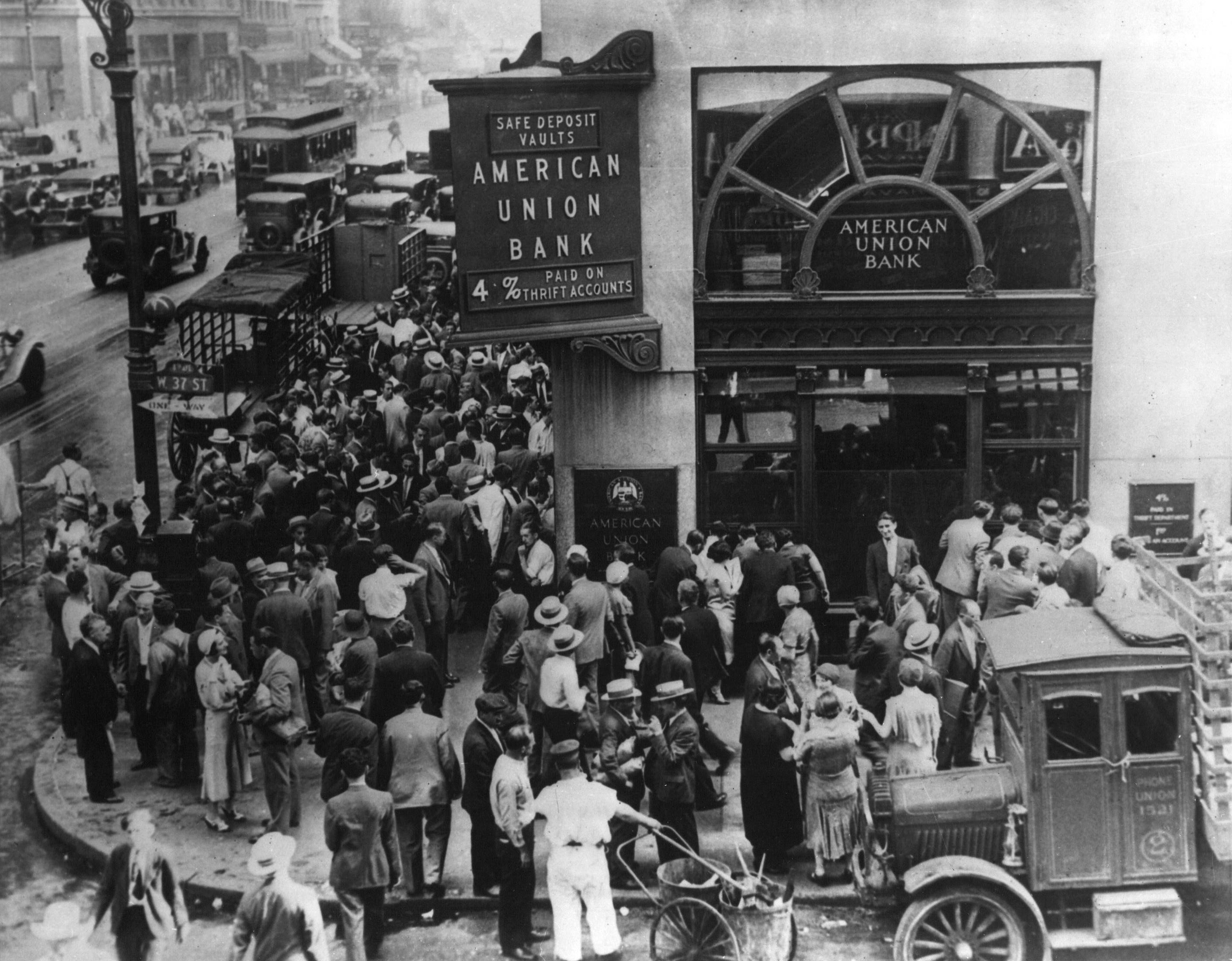
File:American union bank.gif


You really think free advice is worth money?
An old ghost rising up clammier than ever,
You can hear his teeth rattling. Let’s call
Him Fear Itself, and nestle up closer
To the warm and fatherly radio
Whence issue deep and reassuring words.
At the other end of the transmission
A world of static and black-edged clouds away
You can hear the fire crackling in the hearth
And if you strain your ears you might make out
A distant barking, perhaps the voice of Falla,
Woolly anachronism from a lost epoch.
Dogs speak in unintelligible words. Arf!
I take that back: unintelligible
To us. And we’re not reassured. Crisis
Of confidence time, then: credit default
Occurs when you can’t buy what they’re saying.
But wait, did you ever? Bought situation
City all these years and now someone’s
Surprised? Do crocodiles cry rivers
In order to have someplace to swim? Time for
Regulation arrives at one minute
Before the sun yo-yos up into the sky
And that tinny barking starts up again. Woof!
High time to begin drawing limits to thought.
This may be a fight for life. We may find
Both sides of the limit unthinkable. We may
Have to be able to think what can’t be thought,
Credit crunch or no. Credo means I believe
In crop circles. Or did I mean church
May be the last sanctuary of deceived
Believers in the free market dream?
You’ll find a crescent-shaped scar on my wrist
To prove to you this was no mere nightmare.
I’m in a weakened condition so go easy.
What can I do but hand over the payroll?


Fireside Chat: TC, from The New World (Libellum)

Crowd at New York's Union Bank during a bank run early in the Great Depression
: photographer unknown, 1931 (U.S. Social Security Administration)
Banking crisis protest, Reykjavik: photo by Jon Eckman, 2008

Saturday, March 6, 2010

TC: An American Abroad: England in the Mid-Sixties


.


File:Interior East Side of Gonville Court, Gonville & Caius (full).jpg


Tom Clark interviewed by Jeffrey Side, September 2009


JS: When did you first become interested in poetry?


TC: It must have been about 1957 or 1958. The first poems I remember liking a lot--as opposed to merely enduring as school assignments--were by (and I must admit this memory is pretty vague) e.e. cummings and Federico Garcia Lorca (Verde, te quiero verde...).

JS: When did you first start writing poems?

TC: I began then tinkering with some of my own self-serious small verse emissions, strictly in private mind you, in my environment such an activity would have been indefensible, and I've never much enjoyed playing defense.


Then at university it all opened up. The compulsory late Fifties Lowell period was followed shortly by several other more lasting interests, Stevens, Williams... and then there came the shock of encountering Ezra Pound, like walking out one morning and stumbling into in a deep canyon where a broad river gave issue to streams and rillets that led off and back and around and fanned out alluvially to flow toward everything in creation... and one's previous narrow path had been forgotten. Then read world literature as well as all world poetries intensely, acquiring at least at neophyte level such languages as were necessary for the journeying. Did an honors thesis on The Cantos that was published in the East/West Review, Kyoto.

By 1962-63 was writing quite a lot of poetry, won a university prize, had begun to publish. Went over to Cambridge in '63 and during my first year there found myself publishing poems in Poetry (Chicago), New Statesman, Spectator, Listener, TLS, Encounter, etc. That year also, Fall of '63, I took up poetry editorship of The Paris Review.

JS: You were poetry editor for The Paris Review at a young age (22). Did being so young affect your editorial decisions to any marked degree?

TC: No, I don't think so. The boldness or foolishness or whatever it was that caused me to summarily jettison the entire backlog of poems accepted by my editorial predecessor--several issues' worth in fact--probably resulted less from youth than from some permanent quality or defect of character.


At any rate I solicited and published in that venue poems from poets I'd been reading, Olson, Dorn, Creeley, Ashbery, O'Hara, Schuyler, Ginsberg, Duncan, Whalen, Blaser, Wieners, Eigner, Zukofsky, Niedecker, Oppen, Bunting, others; as well as from a number of younger American poets of my own generation and even the next, Ted Berrigan, Ron Padgett, Joanne Kyger, Aram Saroyan; and eventually also, once I'd gone back to the US, Clark Coolidge, Joe Ceravolo, Alice Notley, Jim Carroll, et al.

JS: You studied at Cambridge University in Britain during the 1960s. What was your impression of British poetry as compared to American poetry at that time?


TC: While at Cambridge I met others who were interested in some of those earlier poetries I've just mentioned: Andrew Crozier (who was at Christ's), Jeremy Prynne, John Temple (both of them resident at the college where I was a grad student, Gonville and Caius, the former as a tutor, the latter an undergrad and happily for me my good friend and house mate). The poet Tom Lowenstein was at Kings then, and we became friends; we've stayed in touch all these years. I also met Robert Creeley, whom I'd published and corresponded with (he was at New Mexico then), when he came over to do some readings, including one at the Kings Cross pub in Cambridge, not far from my then digs on the Newmarket Road, across from the Star Brewery and Midsummer Commons. RC and I would remain friends for over forty years.

JS: After Cambridge you studied at Essex University (also in Britain) where you knew Andrew Crozier with whom you edited the magazine The Wivenhoe Park Review. What motivated you both to start a magazine?


TC: In '65-'67 I was at Essex, teaching a bit, working on a protracted and never to be completed Pound dissertation, and there continued to do the PR editing and also started a mimeograph magazine series, Once, that ran to ten issues plus four chapbooks. I featured many of the poets named above (encouraged them to send me all their work, used what I could in PR, the rest in the mimeo). Also published in that series some young English poets I'd gotten to know, like Tom Raworth, Lee Harwood, Tom Pickard.

And yes, while there I also founded and edited The Wivenhoe Park Review with Andrew Crozier, who like me had come over from Cambridge to Essex. As to motivation... It was operated under a sort of official departmental subsidy in that we were afforded the equipment and services of the university print shop. (Whereas my own truly underground mimeo magazine was cranked out in the middle of the night in a broom closet, strictly sub rosa, and then snuck into the outgoing university mail under the disapproving noses of the night porters.) Donald Davie, who'd been my Ph.D. supervisor at Caius, had come over to start the new Department of Literature at Essex; in my second year there he brought in Ed Dorn (from Idaho), so there was that particularly interesting poet, soon a good friend, as company. The Dorns were living on the old Roman Road in Colchester; while at Essex I lived off at the coast in a cottage in Brightlingsea owned by John Barrell (whom I'd known at Cambridge when he'd been an undergrad at Trinity) and his wife Audrey.

Perhaps this comes back to your earlier question, "What was your impression of British poetry as compared to American poetry at that time?"

Well, it was my immediate poetic environment. I would go down to London at the weekend and see poets there, like Tom Raworth in Barnet and Lee Harwood in the East End. Other welcoming ports of call in London were the abodes of the poet Anselm Hollo and the publisher Barry Hall. All of the above became good friends. I also got around the landscape quite a bit to wherever there were readings, it was very much an impromptu read-if-you-show-up scene, so I hitchhiked all round and did readings from Newcastle (with Andrew Crozier, in Tom Pickard's Morden Tower, where too I was able to meet other interesting poets in Tom's orbit, both younger, as Barry McSweeney, and older, as Basil Bunting) to Nottingham (I remember Jonathan Williams, Brian Patten and Adrian Henry showing up at a jamboree reading there) to Oxford (where I read several times, to microscopic audiences of course), all the way down to Bristol (where in the thickets of Somerset I heard but did not see my first nightingale). There were a number of poets I'd routinely bump into on these volunteer junkets. Gael Turnbull, Michael Shayer, Roy Fisher, Jeff Nuttall, Bob Cobbing, Dom Sylvester Houédard, John Furnival were about, Michael Horovitz and Pete Brown were regulars, and Spike Hawkins whose work I especially liked, and also two Canadians, Lionel Kearns and Gerry Gilbert. The American poet Harry Fainlight then living in London was a familiar from that same time. Of course there were many readings in London as well. The biggest was a grand show at the Albert Hall in spring of '65. Readers as I recall were Ginsberg, Gregory Corso, Robert Graves, Adrian Mitchell, Christopher Logue, Simon Vinkenoog, Ernst Jandl and a few lesser lights such as myself. I wore an overlarge black leather coat I'd bought for five quid on the King's Road two weeks before and read my poem "Superballs". Someone deep in the dark reaches of an upper balcony (how many holes would it take to fill the Albert Hall), once I'd announced the title of the poem, hollered, in a Cockney accent, "Wot?" I repeated the title. "Wot? again. A third time I tried. Once more the echoic bellow, "Wot?"

JS: During your stay in Britain, you hitchhiked across the country with Allen Ginsberg while he was visiting there in 1965. You also interviewed him for The Paris Review. What were your impressions of him during this time?

TC: We met at an art gallery in Bristol where we were both taking part in one of those informal, round-robin readings. We'd been in touch by mail, I had solicited poetry, we had had a pleasant correspondence. After the reading there was a crazy motorcycle sidecar ride through the wilds of Somerset and a long crowded night with what seemed like a hundred but was probably closer to ten poets trying to sleep on John James's extremely overcrowded floor. (Beyond which there peacefully slumbered sheep.) Allen, just back from an evidently somewhat exhausting stay in Prague, where he'd been elected King of the May, had a persistent hacking cough, so that the brief periods of sleep for everybody were synchronized with his gulps of some codeine cough medicine he had brought back from Prague along with whatever bacteria.

Allen was the first "international poet" I'd known. He had an acute sense of his international audience and thus, doing an interview in The Paris Review appealed to him immensely. We then hitchhiked together to Wells Cathedral and Glastonbury, where he plucked a flower from King Arthur's grave. There followed intense rainstorms and various further those-were-the-days adventures. Eventually by way of Bath and Reading (this begins to sound like a tale from Fielding or Defoe) we reached London. By then there was perforce a nice empathy. We went on up to Cambridge. Allen camped at my digs, while we taped the interview, on an old, borrowed and beat-up reel-to-reel machine, in several sessions. We went on several expeditions to the Fitzwilliam, where Allen wanted to clamp his glims on the Blake manuscript exhibitions. And he wanted to be taken to meet Morgan Forster at King's, which was nearly a disaster. The great novelist was not at home or at any rate not answering the door to unexpected visitors. I'd been to see him before, but that had been at Forster's invitation, in company with his former student George Plimpton. Allen left his calling card, a handwritten note covered with fields of daisies and skulls and crossbones. Have a nice day!


File:Senate House Passage in the snow.JPG


Interior East Side of Gonville Court, Gonville and Caius College, Cambridge: photo by Jdforrester, 2003

Senate House passage in the snow (with Gonville and Caius Gate of Honour to left): photo by Monsarc, 2009